Speed-to-Lead AI
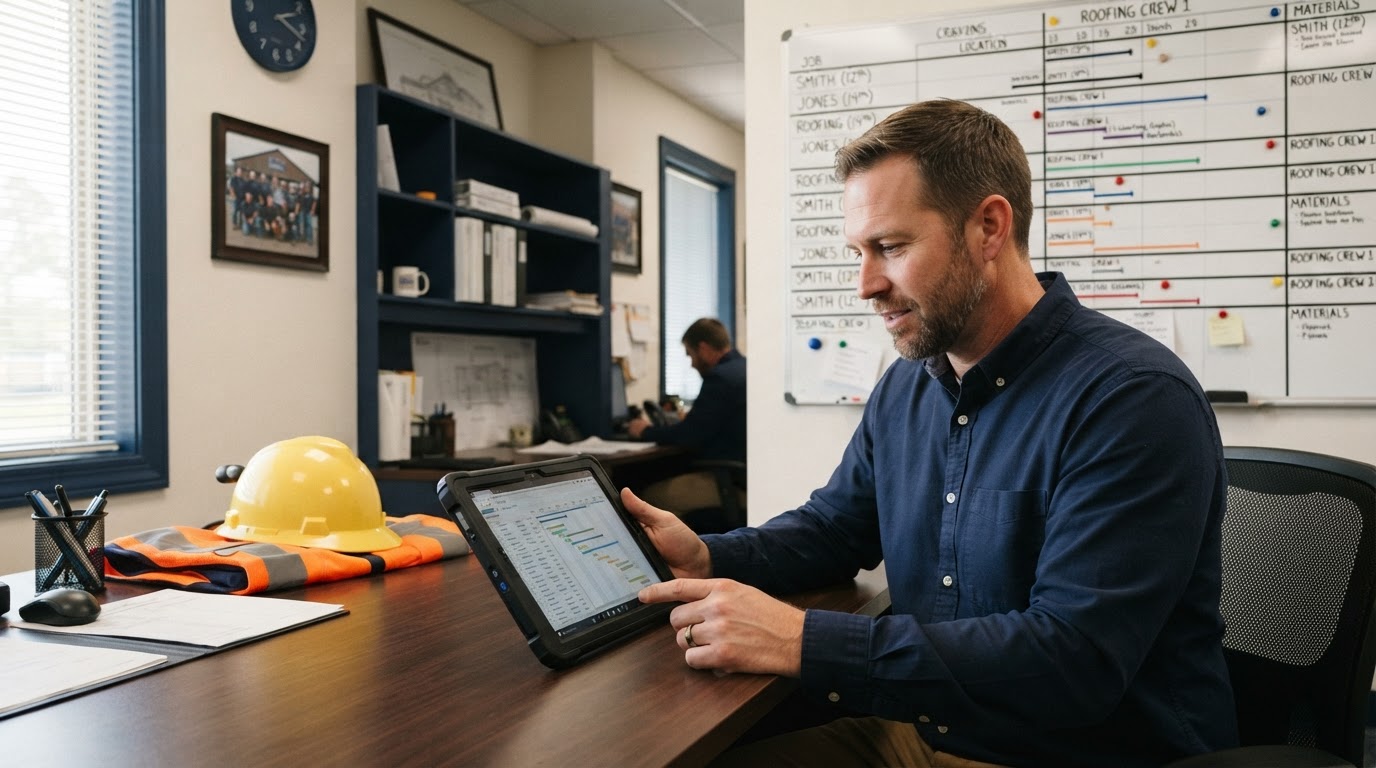
Respond While Your Roofing Team Is on the Job
When a new inquiry arrives, an acknowledgment goes out immediately. Qualifying questions follow to gather context. A human handoff brings the right person into the conversation. Response speed is an agreed target, tracked and validated, not a universal guarantee.
The lead that went cold while the crew was on a roof
Your sales lead is on a roof inspecting storm damage when a homeowner submits a form on your website. The form notification lands in an inbox that nobody checks for three hours. By the time the sales lead comes down from the roof and opens the inbox, the homeowner has already called two other roofers.
The homeowner was not impatient. They needed a roof repair and reached out to the companies that showed up in their search. The first roofer to respond got the conversation. Your company was qualified, but the response came too late.
The gap is not effort. Your team was working. The gap is that the inquiry sat in an inbox waiting for a person who was on a roof. An immediate acknowledgment buys time. Qualifying questions keep the conversation moving. The human handoff brings the sales lead in when they are available, with the context already collected.
Process diagram
Trigger, action, update, owner
Trigger
A new inquiry arrives from any connected source.
Action
An acknowledgment goes out immediately confirming the inquiry was received.
System update
The record moves to Responding with the acknowledgment time logged.
Responsible person
The coordinator owns the response target and the escalation when a reply is needed.
Trigger
The acknowledgment is delivered.
Action
Qualifying questions are sent to gather service type, timeline, and address.
System update
The record is updated with the qualifying answers as they come in.
Responsible person
The coordinator owns the qualification and the routing to the right person.
Trigger
The inquiry needs a human reply.
Action
The conversation is handed off to the sales lead or coordinator with full context.
System update
The record moves to Human Handoff and the assigned person is notified.
Responsible person
The sales lead owns the conversation from the handoff forward.
Trigger
The inquiry arrives after hours.
Action
An after-hours acknowledgment tells the homeowner when the team will respond.
System update
The record is queued for morning pickup as the first priority.
Responsible person
The coordinator owns the morning pickup and the after-hours message.
How the speed-to-lead workflow behaves
The workflow starts with an acknowledgment. When a new inquiry arrives, the system sends an immediate reply confirming the inquiry was received. The acknowledgment tells the homeowner that someone will follow up, and it sets an expectation for when. This is not a human reply. It is an automated receipt that buys time for the team to respond with something useful.
Qualifying questions follow the acknowledgment. The system asks about the service type, the timeline, and the property address. These questions gather context so the human who picks up the conversation does not start from scratch. The answers are stored on the record and routed with it.
Channel limits matter. An SMS acknowledgment requires a phone number that can receive texts. An email acknowledgment requires a valid email address. We configure the approved channels during implementation and handle the cases where a channel is not available. If a homeowner cannot receive texts, the acknowledgment goes to email instead.
After-hours handling is explicit. An inquiry that arrives at 9 PM gets an acknowledgment that says the team will respond in the morning. The inquiry is queued for the first pickup when the office opens. We do not pretend the team is available at 9 PM. We tell the homeowner when to expect a real response.
Escalation brings a human in when the conversation needs judgment. A pricing question, a scheduling request, or a complex storm damage description gets routed to the sales lead or coordinator. The handoff includes the conversation context and the qualifying answers. Duplicate protection catches the homeowner who submits a form and then calls, merging the records so the team does not send two responses.
Exception handling
When the AI response needs a person
A homeowner asks about the cost of a full roof replacement. The AI can acknowledge the inquiry and ask qualifying questions, but it cannot give a price. Pricing depends on the roof size, the materials, the slope, and an inspection. An AI-generated price would be a guess, and a wrong guess costs trust.
The system escalates the pricing question to the sales lead. The handoff includes the conversation so far: the service type, the timeline, the address, and the specific question about cost. The sales lead picks up the conversation with the context already collected and can offer to schedule an inspection. The coordinator is notified so they can track the handoff and confirm the response met the target.
Deliverables
What RoofMaxing builds
Response rules
Configured response targets and acknowledgment timing for each channel, agreed with your team.
Approved message content
Acknowledgment and qualifying question templates reviewed and approved before going live.
Qualification fields
Service type, timeline, and address fields that gather context before the human handoff.
Calendar handoff
A direct path from a qualified inquiry to a booked inspection on the real calendar.
After-hours handling
After-hours acknowledgment and morning queue pickup so no inquiry waits silently overnight.
Monitoring
Response time tracking with median and 90th-percentile measures, distinguishing automated receipts from useful responses.
What your team supplies
Inputs we need from you
- Your response target and the channels you want to use
- Your approved acknowledgment and qualifying question content
- Your team availability and after-hours schedule
- Your escalation rules for when a person is needed
A sample response sequence
Illustrative sample
Automated acknowledgment
Hi Mark, we received your inquiry about a roof replacement. Someone from our team will follow up shortly. Can you tell us the address and when you are hoping to start?
Qualifying question
Thanks, Mark. Is this a full replacement or a repair? And have you noticed any leaks inside the house?
Human handoff
Hi Mark, this is Sarah from the team. Based on what you shared, I would like to come out and take a look. I have Tuesday at 10 AM or Wednesday at 2 PM open. Which works for you?
Illustrative sample. Shows the response sequence. No real customer data.
Measurement
What we measure
Each measure is defined in plain language. Baselines start as "Set your baseline" until your data is connected. The review period is agreed with your team.
—
Median first useful response time
The middle value of first useful response times across all inquiries during the review period. A useful response is a meaningful exchange, not just an automated receipt.
—
90th-percentile response time
The time within which 90 percent of inquiries received a useful response. Shows the slower end of the distribution.
—
Acknowledgment delivery rate
The share of inquiries that received an automated acknowledgment, by channel. Distinguished from useful response rate.
—
Handoff completion
The share of inquiries that needed a human handoff and were successfully routed to the assigned person with context.
Software and access
Speed-to-lead connects to your lead sources, your phone system, your SMS and email channels, and your CRM. We assess your current setup during planning. Channel limits depend on the provider and the access you can provide. We plan the integration before promising a specific response time.
Illustrated workflows
Approved case studies will appear once a real case is documented. Until then, these illustrated workflows show how speed-to-lead connects to the rest of the system.
Questions
Common questions about this service
- No. We treat response speed as an agreed target, not a universal guarantee. We set a response target with your team and track whether each lead meets it. Channel conditions, after-hours timing, and system availability affect actual response times. Any sub-60-second target is qualified as a configured goal and validated under the relevant channel conditions.
Plan the Next Step for Your Roofing Business
Use a 30-minute strategy session to walk through the workflow that needs attention and discuss how RoofMaxing can help.
30 minutes. For roofing owners and operating leaders.