AI-Assisted Insurance Documentation
Organize Roofing Documentation for Human Review
The workflow starts from existing inspection notes and actual photographs. It classifies, flags missing information, and drafts narratives. Outputs support documentation work. They do not determine coverage, create evidence, or negotiate claims. A qualified person reviews every output.
The supplement request that took three days to assemble
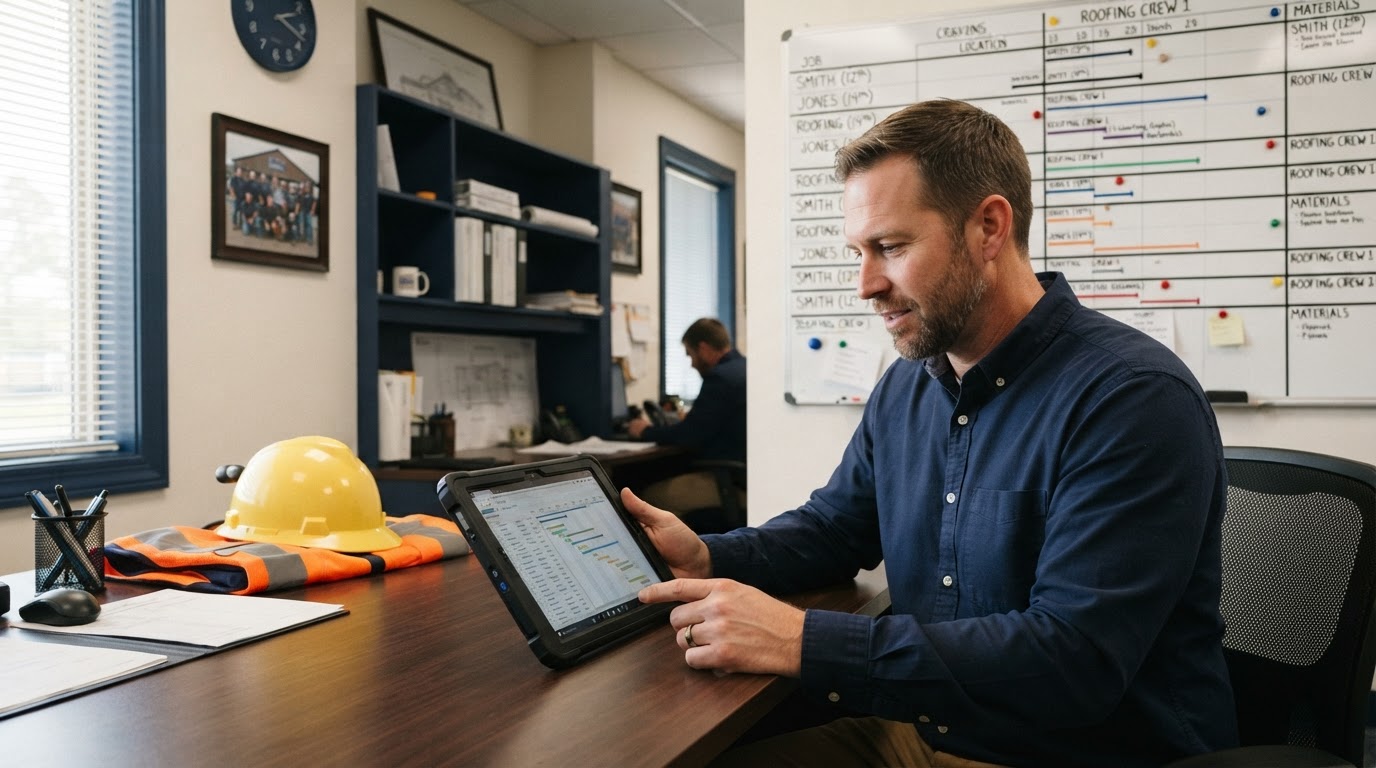
Your estimator inspects a storm-damaged roof and takes forty photos. The notes cover the shingle damage, the decking condition, the flashing, and the ridge vent. The insurance adjuster requests a supplement with organized documentation.
The estimator spends three days sorting the photos, writing the narrative, matching the measurements to the photos, and formatting the package. The supplement is submitted on Friday. The adjuster reviews it the following week. The three days of preparation were three days the estimator was not on a roof.
The documentation did not take three days because the work was complex. It took three days because the organization was manual. A workflow that classifies the photos, flags the missing pieces, and drafts the narrative from the notes gives the estimator a starting point. The estimator reviews it, corrects it, and submits it. The supplement goes out the same day.
Process diagram
Trigger, action, update, owner
Trigger
Inspection notes and photographs are supplied from a completed inspection.
Action
The system classifies the photos and notes by damage type and roof section.
System update
The record moves to Documentation Draft with the classification logged.
Responsible person
The estimator owns the review and the submission of the documentation.
Trigger
A required document or measurement is missing.
Action
The draft flags the missing piece and marks it for collection.
System update
The record is marked incomplete and the missing items are listed.
Responsible person
The estimator owns the collection of the missing information.
Trigger
The classification and draft are ready for review.
Action
The estimator reviews the draft narrative, checks the photo matching, and corrects.
System update
The record moves to Reviewed with the corrections logged.
Responsible person
The estimator owns the corrections and the final documentation.
Trigger
The documentation is approved by the reviewer.
Action
The organized package is submitted to the insurance carrier or the adjuster.
System update
The record moves to Submitted with the submission time and destination logged.
Responsible person
The estimator owns the submission and the follow-up on the supplement.
How the documentation workflow behaves
The workflow starts with what you supply. The estimator provides the inspection notes and the actual photographs from the inspection. The system classifies the photos by damage type and roof section. A photo of hail damage on the south slope is tagged as hail damage, south slope. A photo of damaged flashing is tagged as flashing, valley. The classification gives the reviewer an organized view.
Missing information is flagged. If a required measurement is absent, the draft marks the gap. If a photo is missing for a documented section, the draft flags it. The required-document completeness measure shows which files are missing pieces so the team can collect the information before submission.
The draft narrative is prepared from the notes. The system organizes the estimator's observations into a structured narrative: the inspection date, the roof type, the damage found, the measurements, and the recommended scope. The narrative is a draft. The estimator reviews it, corrects it, and adds the judgment that the system cannot provide.
Reviewer corrections are tracked. When the estimator corrects a classification or a narrative, the correction is logged. The reviewer corrections measure shows how often the initial draft needed adjustment. This helps improve the workflow over time.
The outputs support documentation work. They do not determine insurance coverage, create evidence, or negotiate claims. Coverage is determined by the adjuster. Evidence is the photos and notes the estimator supplies. Claims are negotiated by the roofing team and the adjuster. The AI organizes and drafts. A qualified person reviews and owns the final documentation.
Exception handling
When a required photo is missing
An estimator inspects a roof and takes photos of the shingle damage, the decking, and the ridge vent. The adjuster requests documentation that includes a photo of the flashing at the chimney. The estimator did not photograph the flashing because it looked fine at the time.
The draft flags the missing photo. The required-document completeness measure shows the gap. The estimator returns to the property to photograph the flashing, or provides an explanation if a return visit is not possible. The documentation is marked incomplete until the photo is supplied or the gap is explained. The system does not generate a photo that was not taken.
Deliverables
What RoofMaxing builds
Photo and note classification
Photos and notes classified by damage type and roof section, giving the reviewer an organized view.
Missing-information flags
Gaps in required documents or measurements flagged so the team can collect what is missing.
Draft narratives
Structured draft narratives prepared from inspection notes, reviewed and corrected by the estimator.
Required-document completeness
A measure showing which files have all required pieces and which are missing information.
Reviewer correction tracking
Corrections logged so the workflow improves over time and the review quality is visible.
Approved-tools assessment
An assessment of your documentation tools without claiming universal compatibility with any specific platform.
What your team supplies
Inputs we need from you
- Your inspection notes and photographs
- Your required-document list for insurance submissions
- Your estimator's review and approval process
- Your insurance carrier or adjuster submission requirements
A sample documentation draft
Illustrative sample
- Inspection date: July 15, 2026
- Roof type: Asphalt shingle, residential, 12:12 pitch
- Damage found: Hail impact, south slope, 28 squares. Decking soft in two areas near the ridge.
- Photos: 12 of 14 sections photographed. Missing: chimney flashing, north valley.
- Recommended scope:Full replacement, 28 squares, including decking repair near ridge.
Illustrative sample. Shows the draft format. No coverage decision, no invented evidence. Reviewed by the estimator before submission.
Measurement
What we measure
Each measure is defined in plain language. Baselines start as "Set your baseline" until your data is connected. The review period is agreed with your team.
—
Preparation effort
The time from when the estimator begins organizing the documentation to when the package is ready for review.
—
Required-document completeness
The share of documentation packages that included all required pieces, by submission type.
—
Reviewer corrections
The count of corrections made by the reviewer, showing how often the initial draft needed adjustment.
—
Submission cycle time
The time from inspection completion to documentation submission, showing the end-to-end documentation cycle.
Software and access
Insurance documentation connects to your inspection tools, your photo storage, and your documentation platform. We assess your current setup during planning. We assess your approved tools without claiming universal compatibility with any specific platform. We plan the integration before promising a specific preparation time.
Illustrated workflows
Approved case studies will appear once a real case is documented. Until then, these illustrated workflows show how the documentation process connects to the rest of the system.
Questions
Common questions about this service
- No. The outputs support documentation work. They do not determine insurance coverage, create evidence, or negotiate claims automatically. Coverage decisions are made by the insurance adjuster and the roofing team. The AI organizes and drafts from the information you supply. A qualified person reviews every output before it is used.
Plan the Next Step for Your Roofing Business
Use a 30-minute strategy session to walk through the workflow that needs attention and discuss how RoofMaxing can help.
30 minutes. For roofing owners and operating leaders.